Suppose you want to find a positive integer solution to
Trying a few numbers, up to 10, or 100, or even 1,000,000,000 reveals no solutions... so are there any?
Well, trying a few small numbers without asking for positive solutions might be encouraging. For example, is a solution, as . So is , since too. These actually give you infinitely many solutions, since if is a solution, then so is or actually for any integer . After all, just cancels out completely.
This idea means that actually it's enough to look for a rational solution (with all positive rational numbers) since we can always multiply through by a common denominator to get some integers. It also means that it's really a two-variable problem - if isn't zero, we can divide both and by to get an equation with .
One other observation: if we multiply the whole equation by , we get a neat polynomial equation involving only sums and products of powers of :
or
This is a homogeneous degree 3 polynomial - which just means every term has three terms from all multiplied together - with all rational coefficients.
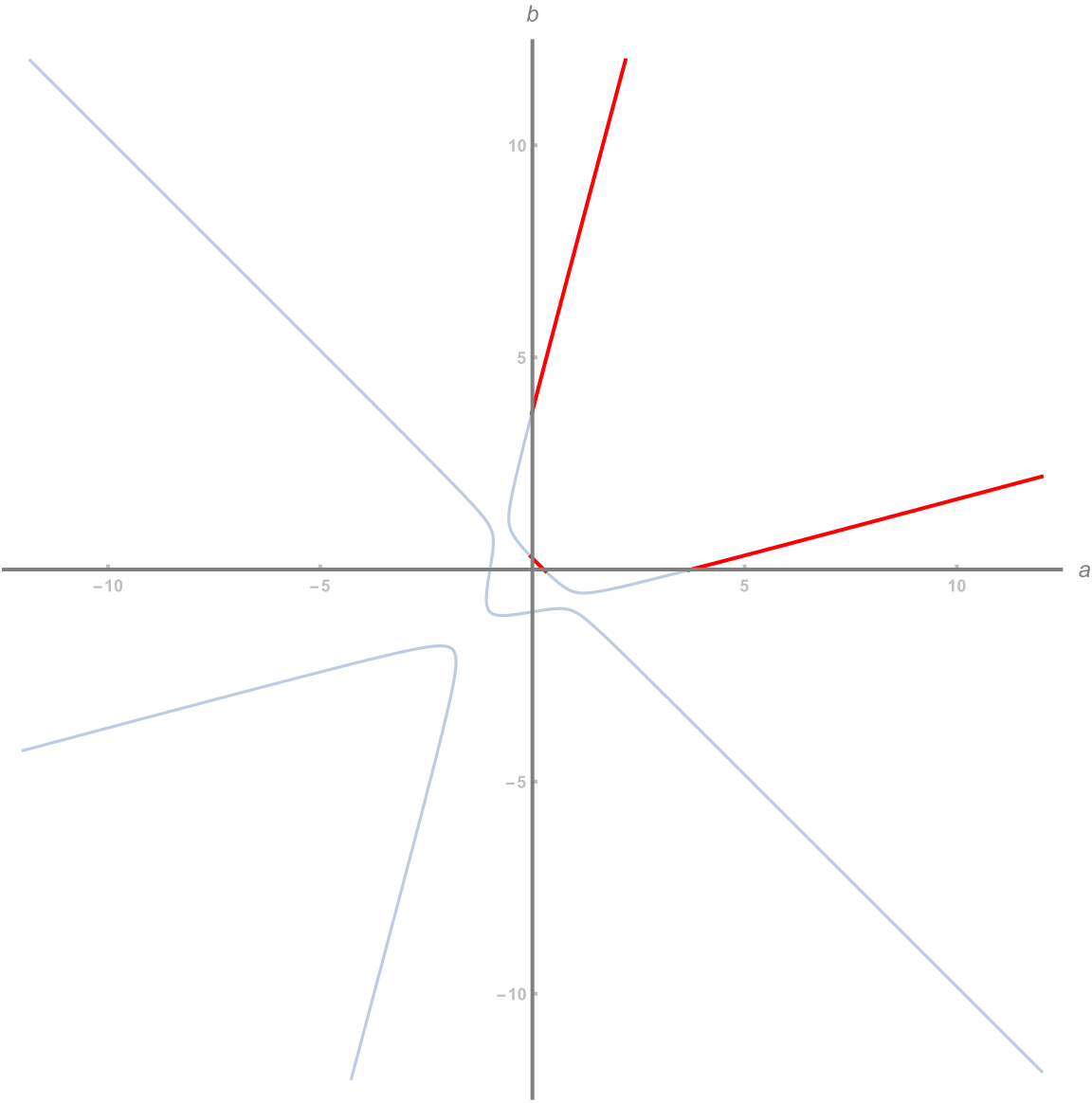
We already know that it has rational solutions ( for example), and in fact this is a special object called an elliptic curve over the rationalS. If we use the trick above to scale down to , we can draw all the solutions:
This is the curve of solutions to the cubic equation
Highlighted in red are the positive solutions - and we want to find a rational point on this red stretch of curve.
Chord and Tangent Games
Well, we know some rational points, like (which comes from dividing through by ). It would obviously be great if we could find a way to put our hands on new rational points given some old ones.
Drawing Chords
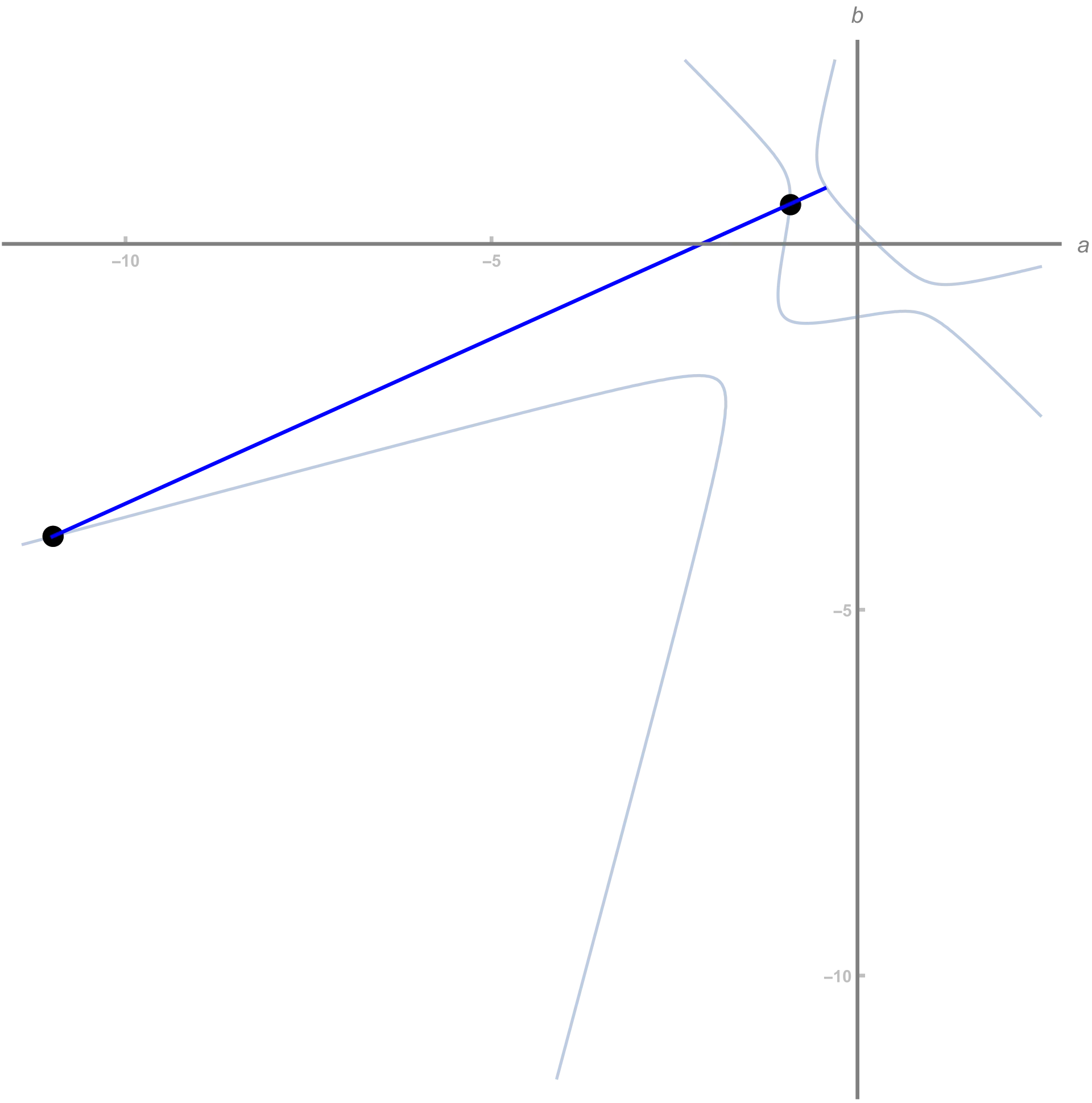
So suppose you have an equation like the one for and that we wrote above, and two solutions at rational points and . What could we try to do to find a new point? One interesting idea is to draw the line connecting these two points together. That is a line with equation
which has rational slope and intercepts, so any time is rational on this line, so is . That's an interesting property. So we could instead write this as
where and are rational numbers:
If you substitute this into the cubic equation we'll get a new cubic equation involving only and a bunch of rational numbers. At first, it will be a mess like
but at the end of the day, it will simplify down to a standard cubic equation , or, dividing by ,
What is this equation telling us? Well, every value of that satisfies it is the horizontal coordinate of a point lying on the line and the original cubic equation of the elliptic curve. So it matches up with an intersection point of the two curves. But we know two of those: the points and , with coordinates and . So these must be two solutions of our new equation. Now a cubic with two real roots must have a third (which might be a double root - we'll come back to that!) and so it's possible to write
which defines a new point corresponding to an third intersection of the line and the elliptic curve. But notice that, since the cubic on the left has rational coefficients, and the cubic on the right contains rational numbers and , the number must also be rational! For example, if are not zero, we can expand the brackets on the right and we get an equation
that fixes this coordinate in terms of rational numbers. Even better, the formula tells us that the corresponding is also rational!
So given two rational points, we can construct a third! This is definitely progress.
Double Roots and Tangents
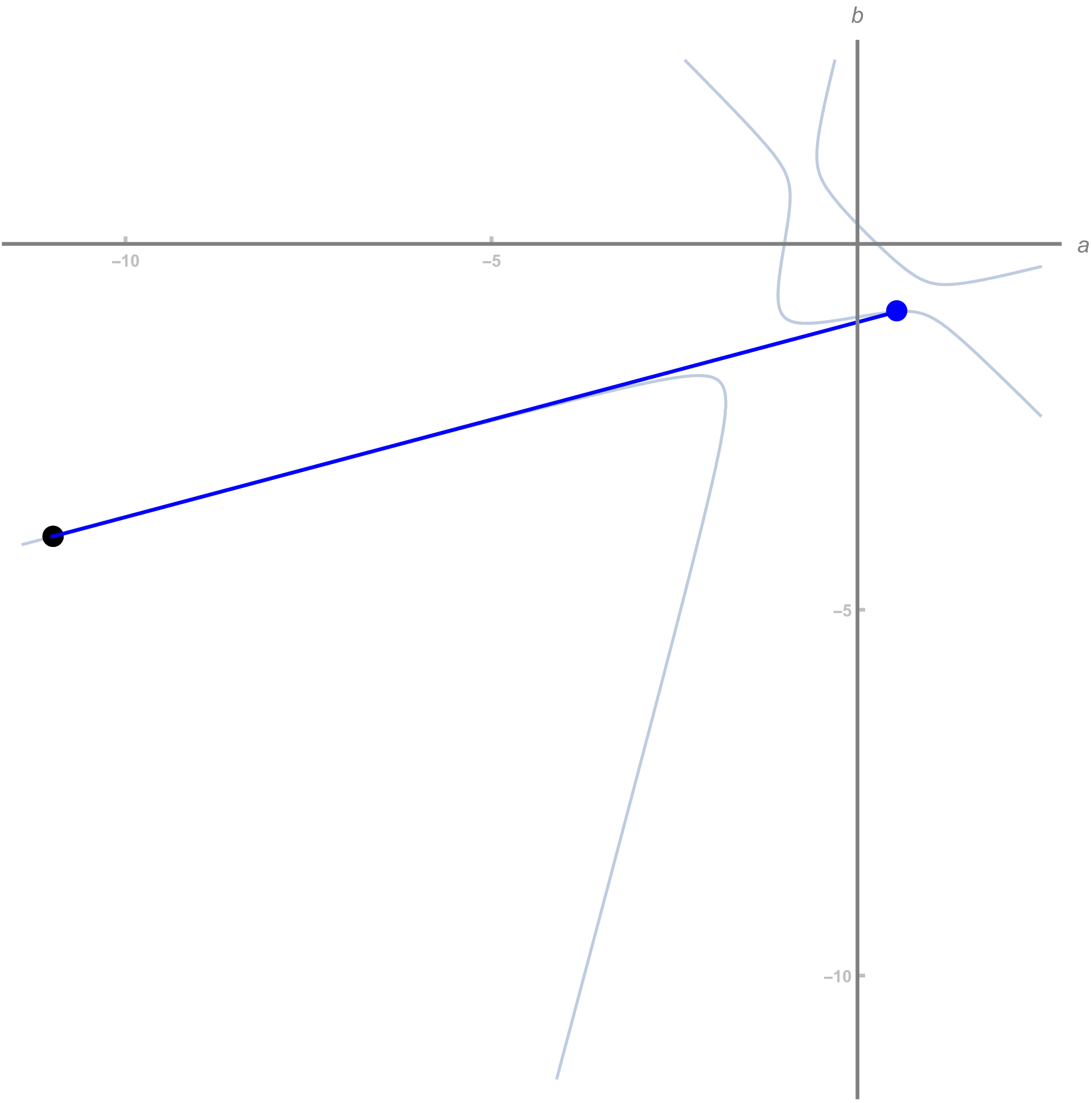
We mentioned something special might happen if there's a double root of the equation. When does this happen? Well, this means that we are on the borderline between having 3 real roots and only 1 real root, which happens when the line just touches the elliptic curve - i.e. when it is a tangent to the elliptic curve:
This is actually really useful. If we have a single point on the graph, and we deliberately draw a tangent there, we know that the cubic will now take the simple form

 This is the curve of solutions to the cubic equation